
Drive past almost any major metro area’s outer ring right now and there’s a decent chance you’ll pass a data center under construction. What used to be a niche building type, low-slung and mostly invisible to anyone outside the industry, has become one of the largest consumers of structural steel beams in the country. It’s changing what fabricators are actually building for.
The scale is hard to overstate. A single hyperscale campus can require more steel tonnage than a mid-rise office building, packed into a fraction of the visible footprint, because so much of the structure is dedicated to floor loading for server racks, cooling infrastructure, and backup power rather than open space for people.
The construction spending numbers are startling
Industry trade coverage puts real numbers behind the trend. Data centers represented more than $65.8 billion in construction spending in 2025, and the pace has kept accelerating into 2026. That places data centers among the fastest-growing categories of commercial construction spending in the country, ahead of segments that have historically dominated steel demand, like warehousing and light industrial.
What makes data centers different from a typical warehouse isn’t the volume of steel so much as the specification. Server floors carry point loads standard warehouse decking wasn’t designed for. Beam selection has to account for vibration control near sensitive equipment, and connection details need to accommodate cable trays, cooling runs, and electrical infrastructure that weren’t part of a conventional industrial design brief a decade ago.
Wide flange and welded sections are working harder
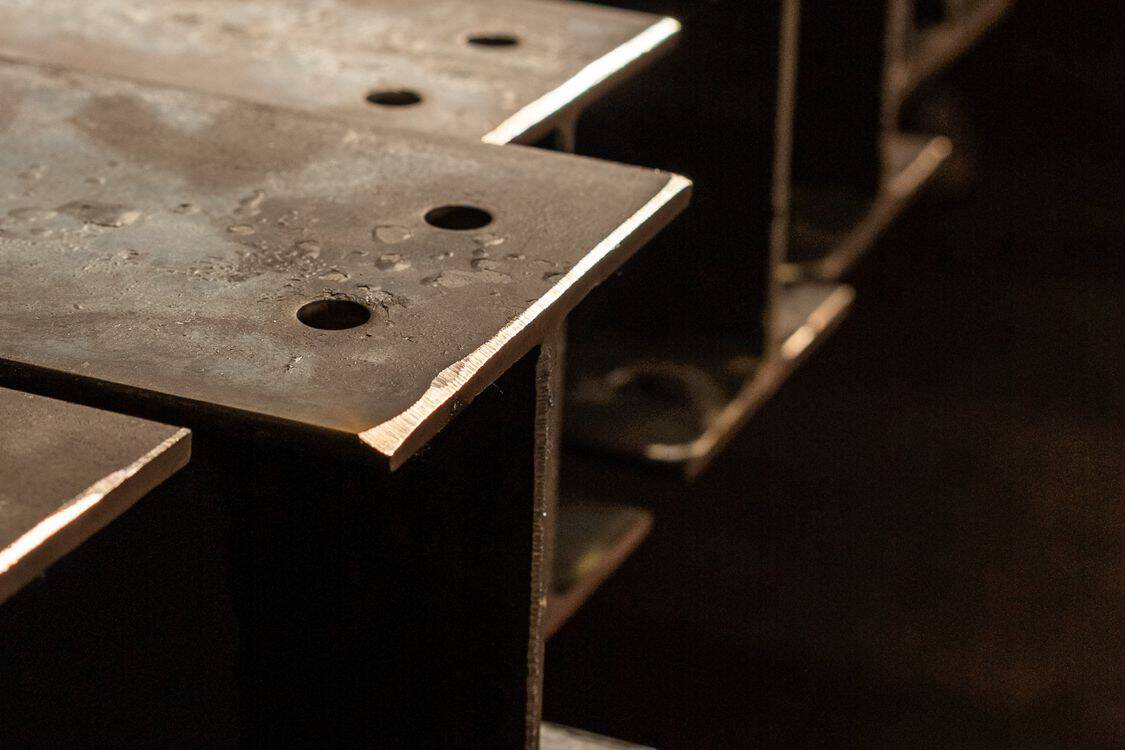
Fabricators supplying this market report a shift toward heavier wide-flange sections and welded plate girders, particularly for the mechanical and electrical floors that support the HVAC and generator loads a data center needs to stay operational around the clock.
Material grade gets more scrutiny too. ASTM A992 remains the standard for most wide-flange work, but projects with unusual load combinations, a mix of static server rack loads and dynamic mechanical vibration, are pushing engineers to specify more carefully rather than default to nominal depth alone. Two beams with the same listed depth behave very differently once flange width and web thickness are accounted for, and that distinction matters more on a data center floor than a typical office deck.
Surface finish decisions matter as well, particularly for exterior elements and rooftop equipment platforms exposed to weather for the 15-to-20-year design life these facilities are typically built for. Coated and galvanized finishes are becoming the default rather than the upgrade.
A supply chain under pressure from two directions
Beam suppliers are navigating this demand surge at the same time raw material costs sit elevated from tariff policy, so fabrication efficiency has become a real competitive edge. Shops that turn around cutting, drilling, and connection assembly fast, with dimensional accuracy that avoids field rework, are winning contracts that might have gone to the lowest bidder in a less time-constrained market.
Lead times are the binding constraint on a lot of these jobs. Hyperscale operators are racing to bring capacity online for cloud computing and AI workloads, and a beam order that used to take weeks now needs to move faster without sacrificing the precision these floor systems require. Some fabricators are prioritizing data center orders over conventional warehouse work simply because the margins and volume justify it. Whether that becomes permanent or fades once the current buildout cools is the question the industry is watching heading into 2027.
Beyond raw tonnage, data center projects are changing how engineers think about connection design. A conventional warehouse floor plan has predictable, repeated bays with straightforward beam-to-column connections. A data center floor often has irregular equipment loading dictated by rack layouts and cooling infrastructure that can change late in the design process as the operator’s technology requirements evolve.
That irregularity pushes connection design toward custom solutions, which slows fabrication if it isn’t managed carefully. Fabricators with experience on this building type say early coordination between the structural engineer and the shop, well before final drawings, has become essential, since a late rack layout change can cascade into beam and connection revisions if the system wasn’t designed with flexibility from the start.
Cable tray and conduit penetrations through webs, once a minor afterthought in beam specification, now get modeled and coordinated in far more detail given how much infrastructure has to route through the floor system. Beams that would have cleared a conventional structural review a decade ago sometimes need reinforcement or resized web openings once the full mechanical and electrical routing plan lands on the drawings.
What distinguishes this segment from conventional industrial construction is how much value gets placed on speed without sacrificing dimensional accuracy. A data center operator racing to bring capacity online has real, quantifiable revenue at stake for every month a facility sits idle, which changes what a fabricator’s turnaround time is actually worth. That dynamic has rewarded shops that invested early in the capacity to handle heavier, more precisely specified sections at volume, even when it means turning away lower-margin warehouse work.
Regional supply has gotten uneven as a result. Fabricators near major data center corridors, Northern Virginia, central Ohio, west Texas, have booked out further than shops in markets without that concentration of hyperscale activity. A general contractor bidding a conventional industrial project in one of those corridors right now may find beam lead times running longer than usual, not because overall steel supply is short, but because the local fabrication capacity is tied up on data center work that pays better and moves faster through the shop.